
Q&A with Elisa Faison: Author of Skin Contact

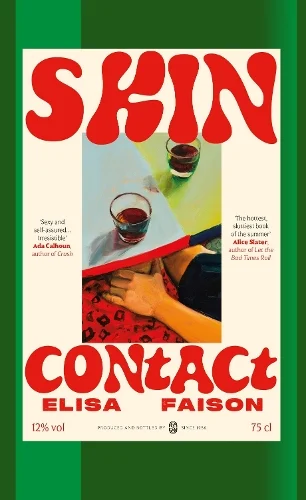
Please introduce yourself and your debut novel...
Hi! I’m Elisa Faison. I’m a freelance editor & I live in Carrboro, North Carolina with my husband and my two-year-old twins.
In 2021, I’d recently completed a PhD dissertation about motherhood and domesticity in the twenty-first-century American novel and I was working as a bookseller, determined to sell as many copies of Meg Mason’s Sorrow and Bliss and Rachel Yoder’s Nightbitch as I could. I loved recommending books about complicated, angry women; about yearning, avoidant, bisexual women; about tumultuous and beautiful marriages. But as a reader, I was finding myself frustrated. Where were the portrayals of bisexual women who were actually sleeping with women? Where were the portrayals of open marriage that didn’t ultimately suggest they were a doomed or even dangerous phase? Where were the portrayals of polyamory that were as intimate as those of love between two people?
Here’s what else was going on in my life: I was mourning my mother, who died in 2020, and my grandmother, who died in 2019. I was in a very happy open marriage with my husband, Wil. I was in denial that my relationship with my girlfriend was over. And I was trying to become pregnant. It was a lot.
I managed my feelings about it all the best way I knew how: by writing about them in what would eventually become Skin Contact.
Skin Contact follows Ben and Frances, a bisexual married couple in their 30s. Reeling from her mother’s recent death, Frances feels as if she’s lost her sense of purpose, and Ben will do anything to help her. So when she suggests that they open their marriage, he’s willing—and a little intrigued.
Over the next five years, they explore their sexualities, navigating through jealousy, betrayal, desire, and obsession—and the friends and lovers in their circle find themselves asking new questions about their own lives and relationships. But when each is pulled in a new and unexpected direction, Ben and Frances are forced to confront the consequences of their experiment.
Mirroring polyamory’s open structure, Skin Contact also invites the perspectives of others into its intimate study of a marriage. In doing so, it endeavors to examine love and relationship in their many forms, across lifestyles and generations, with care, curiosity, and hope.
In some ways, Skin Contact is a love letter to the many different people I was over the three years I spent writing it– because by the time I got to the end, I was mother to a set of wild, beautiful, difficult one-year-old twins. It’s also an ode to the friends and family who were challenging me, changing with me, and loving me that whole time.
How would you define intimacy, and how is it explored in the novel? What is the role of touch in platonic and romantic relationships in the novel?
At its heart, I think Skin Contact is an exploration of intimacy. The title reference is to skin contact wine, but it’s also to skin-to-skin contact between a parent and a newborn. Physical touch is the first way we learn to build intimacy, and through that intimacy we ideally build trust. I think when we think of something being “intimate,” we immediately think of sex – probably thanks to the lingerie industry calling underwear “intimates”! But I wanted to consider intimacy in its many forms in this novel – sexual/romantic intimacy for sure, but also the intimacy between mothers and children, and between friends.
I think physicality is more present in familial and platonic relationship than we often consider or discuss. As I’ve become a parent, I’ve not only become more aware of how physical (sometimes devastatingly so!) mothering is, but I’ve also been more attuned to the ways I remember my own mother physically – the smell of her hair, the weight of her arm on my shoulder. Covid revealed to me how important physical intimacy was in my friendships, too.
I remember wanting to hug my friends in an almost overwhelming way. But this played out in complicated ways for different people. I remember one friend saying that for some reason, she couldn’t wait to share drinks again; another responded that she thought she’d feel disgusted by the idea of doing so for the rest of her life.
Across relationships, I wanted to depict intimacy as precious and carefully-crafted – and therefore vulnerable to cracks, even in friendships, even in parental relationships.
How have relationships been affected by the pandemic, do you think? Is it unavoidable to mention the pandemic in contemporary fiction?
From the start, I knew that this novel would be sewn together from multiple perspectives and stories. I initially wrote “Motherlove” (which would become the first chapter of the novel) as a stand-alone short story. But I quickly realized I wanted to know more about these characters, and I found myself writing “Group Sex” soon after.
I initially envisioned the full work as one which followed Ben and Frances in a long through-line (which it still does!) but that was interspliced with break-off stories about the people they’d met or dated. It would mirror the experience of a dating app – you see someone briefly and maybe they disappear, or maybe they become important to your story; or maybe, later on, you glimpse that lost person across the aisle in the grocery store, but find you can’t get any closer. It can be a sad, frustrating, and beautiful experience to know some people intimately, but for a short time.
But I was surprised, in writing, to find that what felt truer to me in writing about an open relationship was to consider how friendships changed with coming out. Suddenly, you’re blasting open the private space of your marriage, and everyone’s invited in – not just romantic partners, and not just in a sexual sense. You open to scrutiny, you open to questions. And I found, too, that I had new questions. What would my mom have thought of this? What would my grandmother have thought? What were their marriages like? What had they hidden, or what were they open about with me?
It’s scary, but it can be a really beautiful process. You’re allowing yourself to break barriers in platonic relationships, too. To show the worst and the best and the most vulnerable of yourself and your primary relationship. I found myself writing several chapters from the perspectives of friends who all had different opinions on Ben and Frances’ choice – and this felt fruitful to me as a way to explore relationship in general. And I enjoyed exploring the tension between what comes out into the open, and what remains hidden. There are many characters who keep things private, who avoid sharing certain intimacies. Sometimes this choice can be as revealing.
How important do you think it is for couples to want the same things in life, and how do Frances and Ben grapple with their changing desires?
I think it’s very important that couples who stay together want the same things in life – and I also think that the process of discovering what you want can be messier than we’d like to think.
It’s a big moment right now for bad polyamory and what Dan Savage has called “tolyamory” (meaning, accepting nonmonogamy in order to save a relationship). I feel like every time I open the internet, a new man has decided to invoke non-monogamy as an excuse to cheat with impunity (see Lily Allen’s West End Girl, or Lindy West’s Adult Braces, or Megan Thee Stallion’s breakup with Klay Thompson!). As someone in a non-monogamous relationship with a man that’s happy, healthy, and consensual, I’d love to put a stop to everyone’s jerk husbands/boyfriends using polyamory as an excuse to be terrible. You’re giving us all a bad name!
I also think that because of all these bad men (and probably bad people in general, though the men make most headlines), polyamorous people feel the need to present their stories as smooth-sailing, perfect, hard work and good results. Like any relationship, polyamorous ones can be messy, rocky, and complicated. The people involved might evolve and change at different rates. This is true of monogamous couples, too -- in their journeys to parenthood or marriage, say. It’s just that the mess of polyamory is more public, more out-there, and easier to worry about.
With Ben and Frances, I wanted to depict a healthy and happy version of polyamory through characters who love and trust one another. And sometimes, that meant showing the cracks, showing the mess, and showing the hurt along the way.


Comments